By Carmen Rodgers
Elmore Autauga News
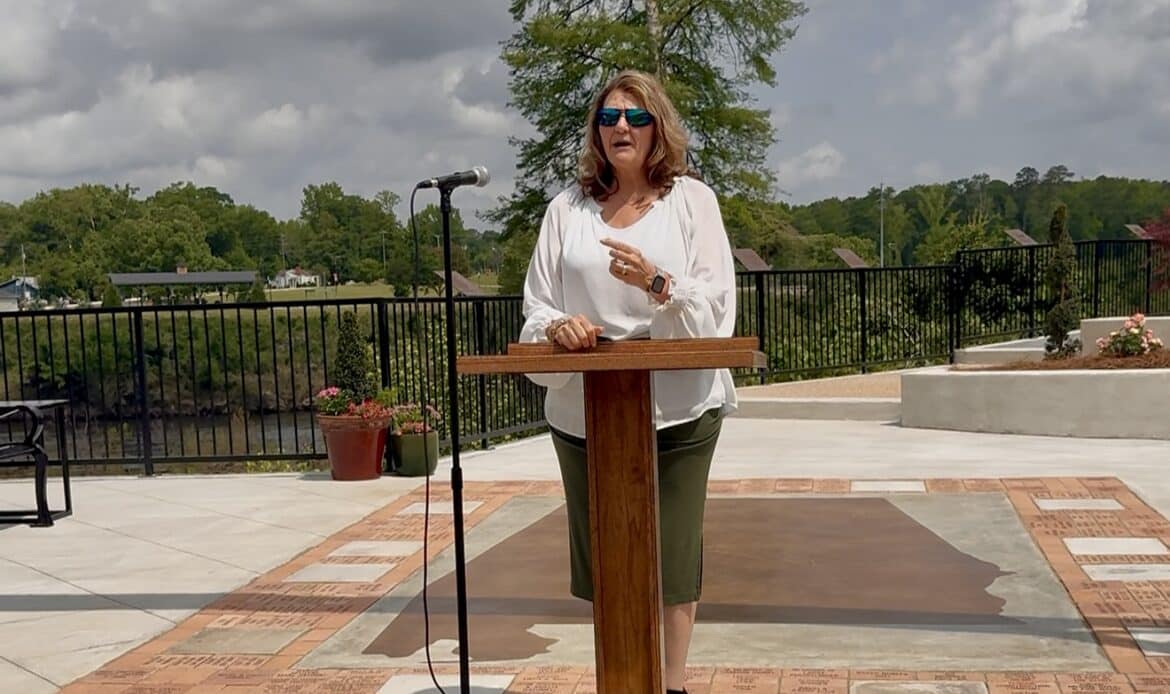
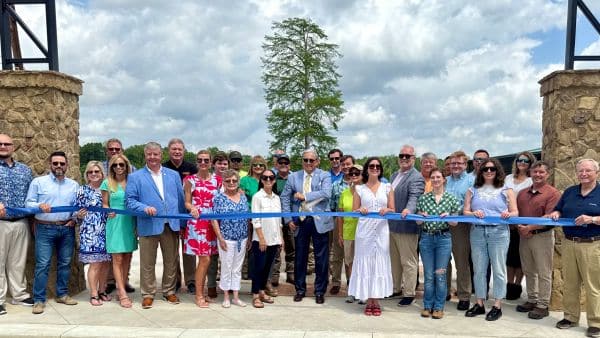
Main Street Wetumpka recently hosted a ribbon-cutting ceremony to celebrate the opening of Fall Line Park. Main Street Wetumpka Executive Director, Haley Greene, welcomed all in attendance and recognized the dedicated park curators for their hard work and vision in bringing the park to life.
“It’s been a long time coming,” Greene said. “The official ribbon-cutting for Fall Line Park.”
“Thank you for your support, your guidance and your vision. You are the reason projects like this happen. A very special thank you,” she continued.
President/State Coordinator at Main Street Alabama, Mary Helmer Wirth, also addressed the crowd.
“Main Street is a family and downtown district is a place where everybody can call home everybody gets a piece of it. Everybody gets to participate in it. It takes so many people to do the right thing,” she said. “You guys are amazing. I love what we are doing here.”
Wetumpka was one of the original Main Street Alabama communities. Jenny Stubbs, who was present for the ribbon-cutting, was the first Director for the local nonprofit. Wirth recognized Stubbs for her hard work and dedication to the organization.
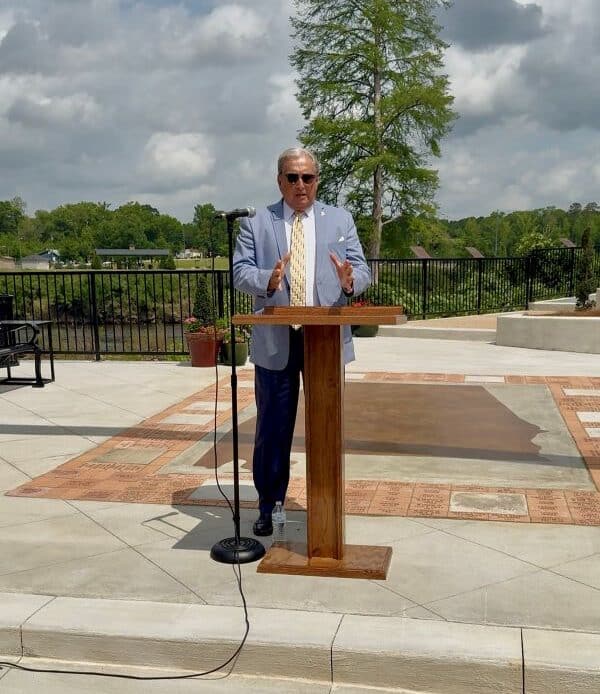
Main Street Alabama Treasurer & Finance Committee Chair, Dennis Fain, spoke at the ribbon cutting.
“Things like this just don’t come out of the ground. They have to have funds. You have to have money,” Fain said. “You have to make a vision a reality. I want to thank our primary funders of this.”
“The entire project was made possible by fundraising efforts that’s what so important. Through individual donations, grants, and so forth. This park cost $130,000. We raised every penny of it,” Fain continued.
Bobby Barrett with the Wetumka Lions club spoke about Sam Turner.
“I started getting this together, everything about Sam Turner. They said, “You have two minutes’. You cannot cover everything about Sam Turner in two minutes. I’ll try to cut it short,” Barrett said. “Sam was a very, very dedicated Lion. He was in Lions Club for 52 years and 2 months.”
Sam’s father Cliff was a 50-year Lion’s Club member.
Wetumpka Mayor Jerry Willis spoke at the ribbon-cutting.
“So good to be here today, to witness this occasion,” Willis said.
Willis also thanked park curators for their efforts to make Wetumpka a great place to live.
“They caught on. They saw the vision. They know what we’re trying to do in Wetumpka and every day they’ve been supportive of what we are attempting to do here,” Willis continued. “Folks, we aren’t finished. I can promise you; we aren’t finished. There’s a lot more coming to Wetumpka. This is a great day. This sitting right in front of Kelly, which is another great development that has happened in Wetumpka. So, we applaud everyone that was involved in this. And can simply say, we love Wetumpka.”
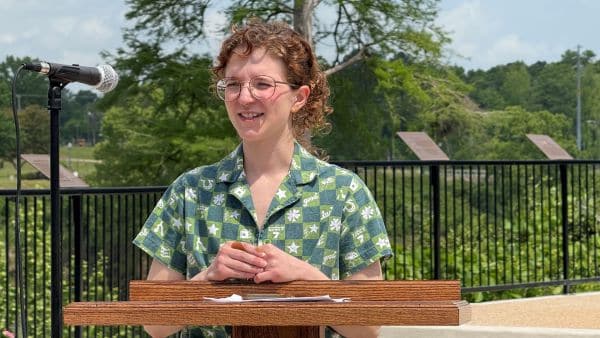
To highlight the significance of the park’s name, James Mays from Auburn University, and a student of Dr. David King, took the stage to explain the geological and historical importance of the Fall Line, offering attendees insight into the natural landmark that inspired the park. Dr. King originally characterized the Wetumpka impact crater.
“I’m here today to talk to you about the Fall Line,” she said. “It marks the border between two different geological provinces that part of Wetumpka lay in.”
The Fall Line separates the Appalachian Highlands and the Coastal Plain.
The Appalachian Highlands stretch all the way from Newfoundland in Canada down to right here in central Alabama, covering about 2,000 miles.
The Coastal Plains is a low-lying area of mostly flat land that is adjacent to the ocean. In the US, it stretches along the Atlantic Ocean and the Gulf of Mexico, spanning from New Jersey to Texas.
The Coast Plain formed during the Cretaceous Period.
“A period of extremely high sea-level, and a lot of continental flooding. That flooding caused the creation of the cretaceous Interior Seaway and the coast plain where we, and a lot of the southeastern states in the United States rest,” Mays explained.
This is why marine sediment can be found in the area.
“There is a lot of preferential weathering that causes the elevation to be starkly different between these two provinces, so we have very distinct low elevation and slope down here and a high and steep slope towards the Appalachians,” Mays continued.
Because the landscapes are so different, wildlife and plant life can also vary greatly between the two regions.