

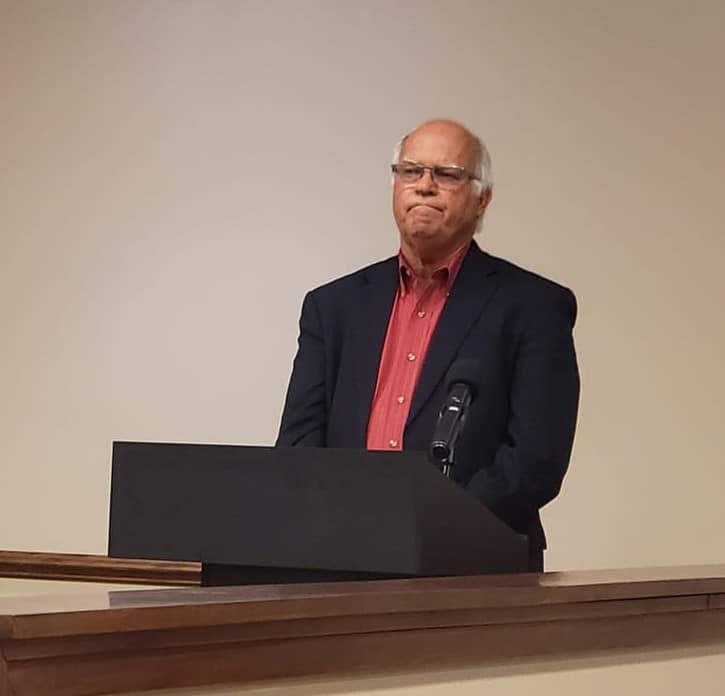
BY SARAH STEPHENS
ELMORE/AUTAUGA NEWS
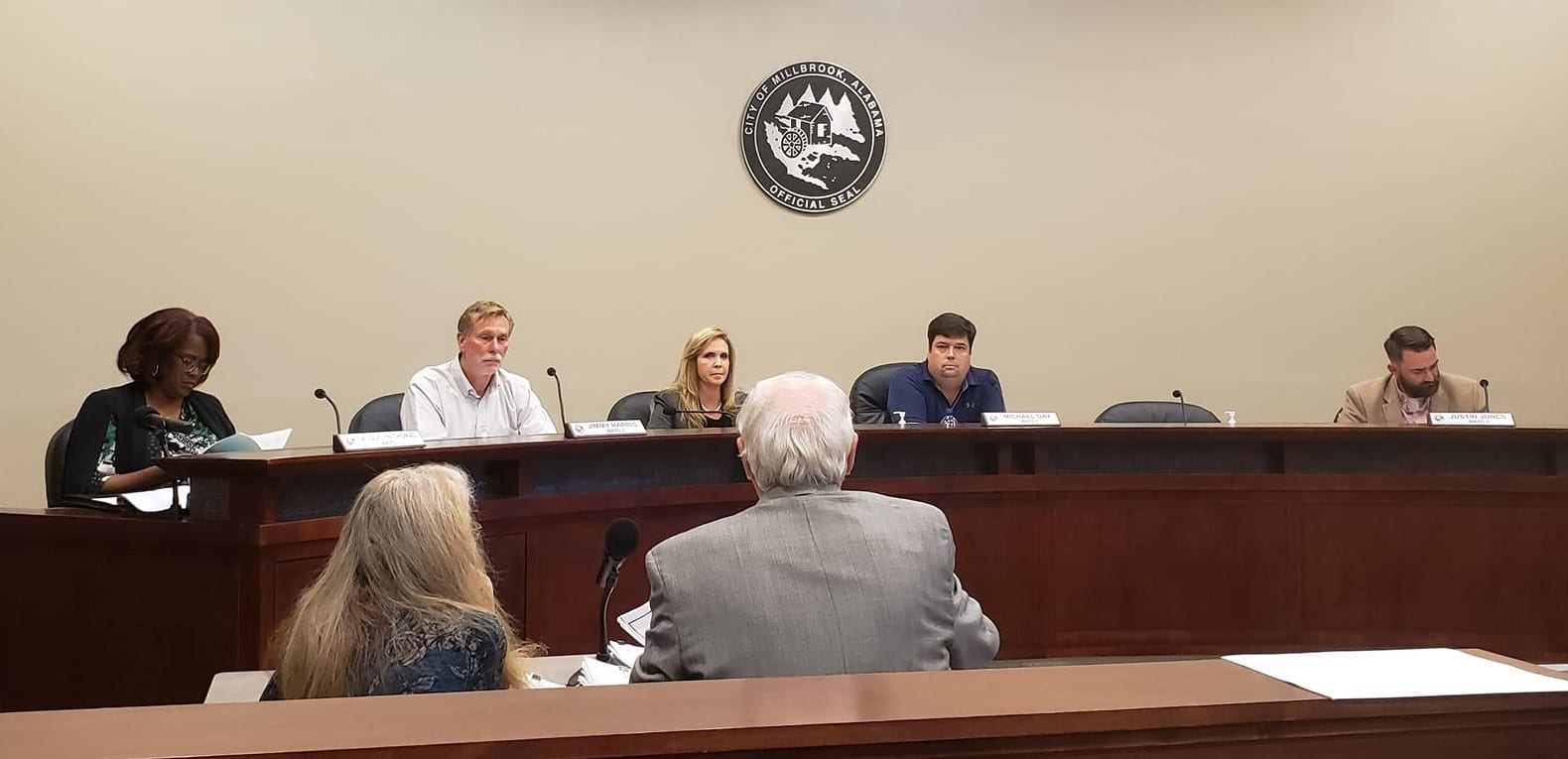
A Post-Termination hearing Wednesday afternoon for longtime Millbrook Chief Magistrate Tammy Pugh lasted for nearly four hours, followed by an executive session with the Millbrook City Council. Upon returning from the executive session, the Council voted 4-1 in favor of upholding Pugh’s termination.
Voting in favor of her termination were Council President Michael Gay and Councilors Hal Hodge, Jimmy Harris and Justin Jones. Voting against the termination was Councilwoman Jacquelyn Thomas.
Tammy Pugh did not testify at the hearing, but was present and represented by her attorney Jim Debardelaben of Wetumpka.
Called to testify on behalf of the city were Police Chief P.K. Johnson, Millbrook Municipal Court Judge Lynn Bright and Mayor Al Kelley.
No witnesses were called for Tammy Pugh, but her attorney did question the city’s witnesses.
Debardelaben argued that Pugh was unjustly terminated without official documentation to provide reasonable cause. He argued that “off the record conversations” that allegedly occurred with Pugh, were not documented, and follow up or action was not taken. Debardelaban said that since Pugh’s hiring as Chief Magistrate in 2001, she has received good, annual evaluations and merit raises.
Representing the city was attorney Jeff Courtney. He argued that Pugh’s ultimate firing was for the recent discovery that bond forfeitures were not being made resulting in hundreds of thousands of dollars not being collected, among other things.
He also spoke of issues over a period of years that arose predominantly with personnel complaining against Pugh, and a high turnover rate of employees.
There is an ongoing investigation into the total amount of bonds not forfeited by the City of Millbrook.
Additionally, the city was in arrears in the amount of over $5,000 because fees had not been paid to the Alabama Department of Forensics Science for results from breathalyzer tests after DUI arrests.
This has since been resolved but testimony showed the non-payment put the city at risk of losing the ability to use the breathalyzer machines. Finally, it was revealed during testimony that when traffic tickets went unpaid to the court, the proper authorities were not notified, and the licenses were not suspended. This allowed the driver to maintain a current licenses or apply for a new driver’s license.
In opening statements, Courtney was first up for the City.
Courtney said that Pugh was given her termination letter on March 1 and the reasons for that termination are set forth in the letter. We have requested a copy of that letter which was filed as evidence during the court proceeding.
Because the matter is under investigation, city officials said they cannot comment at this time, other than public comments during the hearing. We have also reached out to Debardelaben concerning several questions we have that came out during the hearing. We will update this story accordingly if requested information is forthcoming from either the city or Debardelaben.
“Tammy Pugh has worked for this city as a circuit clerk for 20 years. No problems under Judge Ben Pool. Her annual evaluations showed no problems. All I have is her file back to 2015. (City officials) might say they were all self-evaluations. But they were all approved by (Millbrook Mayor Al Kelley) except for 2021.”
In February, there was a pre-disciplinary letter sent to Pugh announcing there would be a hearing to discuss her continued employment with the City. In that letter, DeBardelaben said there are no specifics in the letter for what Pugh did to result in her termination.
When she was issued the official termination letter on March 1, 2022 reasons were given, but not prior to the first hearing, Debardelaben said.
“If it is not in the personnel file, it didn’t happen. They can testify all they want,” he said.
Debardelaben said he has reviewed the personnel rules and regulations for city employees, as well as disciplinary actions. Handling of formal counseling and verbal counseling are included in the personnel book. DeBardelaben said it was up to Pugh’s supervisor to create a memo of disciplinary counseling. “The supervisor will create a memo date, time, subject and response to a meeting. Did it happen? Who knows? They didn’t follow the rules.”
On written reprimands, Debardelaben said there was one in February 2019. But her evaluations following that continued to show she was doing her job.
He argued that if counseling was ever done and improvement suggested, within 30 to 60 days the city should have followed up if that improvement was not seen. Debardelaben said there is no record of that happening.
“Calling you in a back room and talking to you about it, maybe, if you don’t do what is in these rules, you haven’t done your job. You haven’t told that employee (with documentation.) That employee is entitled to get what they say in the personnel manual. That is part of due process.”
Debardaleben spoke of longtime Municipal Court Judge Ben Pool, saying that during his 40 years with the city, there were no documented issues with Pugh.
“Judge (Lynn) Bright comes in. She is used to a different system.”
He argued that he is not sure who Pugh’s immediate supervisor is, saying that Pugh was supposed to answer to the judge, but the Mayor approved the annual reports.
“If I get an annual report that says I am doing a good job, and then four or five months later you want to fire me? There has been no written disciplinary procedures, no write ups, nothing placed in my file…where is your due process?”
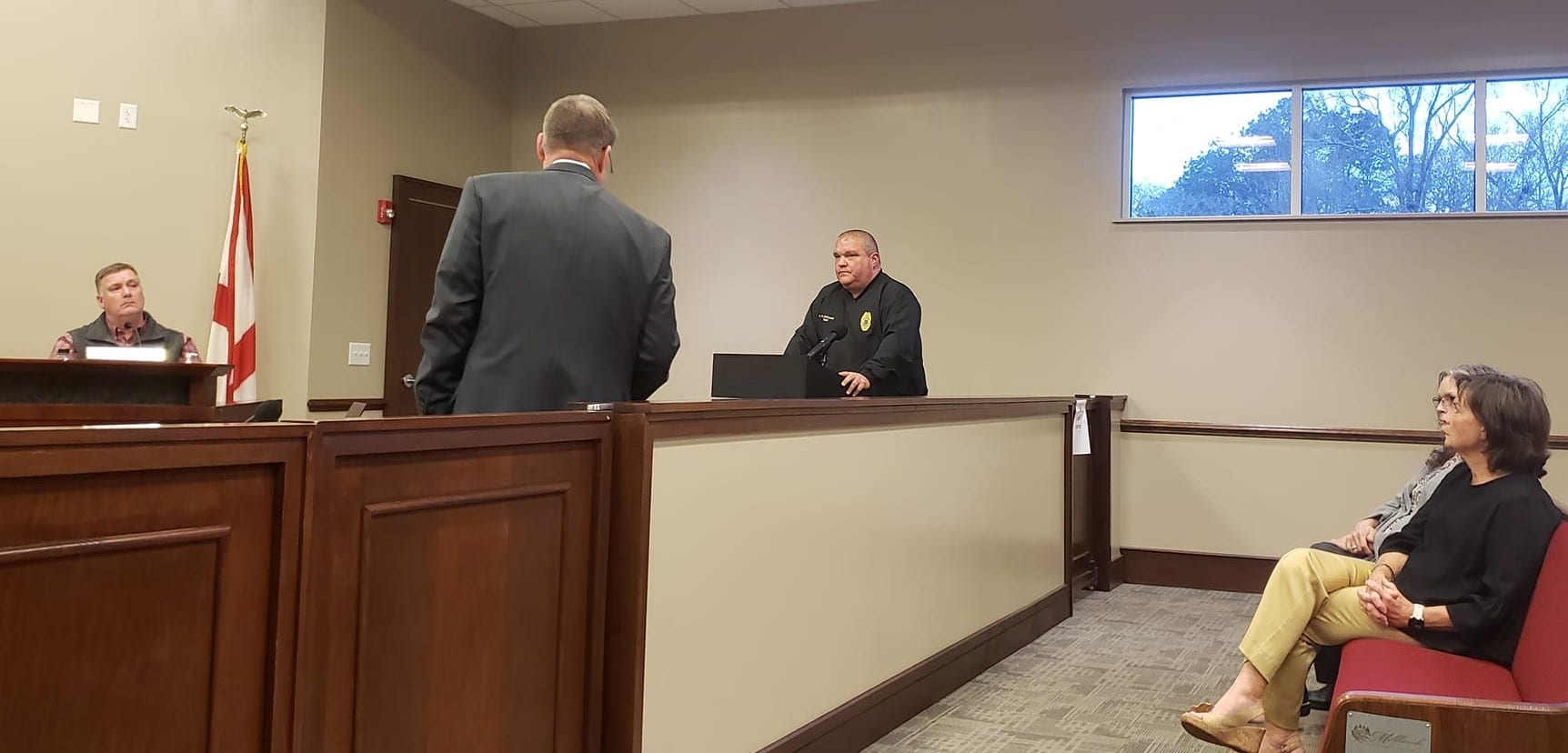
Attorney Courtney then presented witnesses, first being Millbrook Police Chief P.K. Johnson.
Courtney asked Johnson to describe the level and quality of communication he had with Pugh while she was employed with the city.
“Poor at best,” Johnson said. “For a number of years Ms. Pugh has had a tendency to want to critique officers’ work products for what we call pro, on view arrests.”
This refers to cases where officers witness what they believe is criminal behavior, but a warrant has not been issued. Johnson said that in numerous circumstances Pugh would refuse to sign off on those arrests. This was done without communication with him, and he only learned of it when officers came forward to him personally. He said when he reached out to Pugh, she would argue with him as well.
“A lot of times, (Pugh) would (attempt to) try the case in my office. I explained to her that is not a magistrate’s role.” He said that on a pro arrest, those facts would be put before a judge at a later date, but the arrest could be made.
In another example, he said that Pugh would often complain about his officers for various issues, but would not contact him personally.
Johnson also said there was an ongoing problem with a magistrate not being available to officers after hours to obtain warrants in cases that were not on view arrests.
He said this required officers to have overtime because they had to come in on their off time to get warrants for their cases. He said he learned from court department employees that Pugh had instructed them not to be available to officers after hours.
Debardelaben called Johnson’s comments hearsay, and an ambush, because there was no documentation to back it up.
Courtney responded that in Pugh’s March 1 letter, she was given reasons for her termination which included performance, attitude, work habits, personal conduct and more.
Johnson was asked about Pugh’s office environment. “There were times when we were looking for paperwork,” Johnson said. He continued that the court department would say they did not have it, but at times it was later discovered in the court department.
Johnson said that a major issue arose when he became aware that the court department no longer had the ability to check criminal backgrounds in preparation for upcoming court cases. He said his office made arrangements to provide Judge Bright with information on criminal histories, but within the law he could not give her the actual documentation. “I could tell the judge what it said, but I could not give her that document. That should have been done through the court department.” He continued saying, “I know in the past (the court department had the ability to pull criminal histories) but at some point in time they lost it.”
This forced his staff to look up criminal histories so he could relay the information to the judge.
When he requested information from Pugh about this issue, he said he got very little, if any, response.
Debardelaben took issue with an email that Johnson sent to all personnel including Pugh regarding the bond schedule for the court after Judge Lynn Bright replaced Judge Poole as Millbrook’s judge. Poole resigned shortly before he passed away.
By that time, Johnson said Pool’s bond schedule created for the period of Covid had expired. He said Judge Lynn Bright told him to go back to the bond schedule prior to Covid as restrictions by the Elmore County Jail on new prisoners had lessened.
Debardelaben asked if Judge Bright had issued a new bond schedule. Johnson said that other than his conversation with Judge Bright he was not aware if she had.
With the advent of COVID and the desire to limit the amount of prisoners in custody on municipal court actions, the bond schedule had been reduced by Poole while he was still serving.
Judge Bright went back to the original bond schedule when the Elmore County Jail started allowing more inmates to be housed.
Johnson described this time period of Covid restrictions as “Catch and Release” for those arrested unless it was DUI, domestic violence or a violent crime.
In other issues, Johnson said in January 2020 he sent an email to Pugh when he learned that the court department owed $5,000 to the Alabama Department of Forensic Science related to testing for breathalyzer exams. The court is required to pay these fees by law. Johnson said when he did not receive a response, he sent a second letter, but again received no response.
Debardelaben said that Johnson did not have authority over Pugh as he was not her supervisor. Johnson said he was just making Pugh aware of the situation so it could be corrected. In the letter, Johnson said that if the situation was not resolved, he would have to make Mayor Al Kelley and other city officials aware that the city owed $5,000 in back fees. “We were going to lose the breath testing instrument because the court department had not submitted funds due the state,” Johnson said.
Johnson said he never filed a formal complaint concerning Pugh but did have several conversations with Mayor Kelley about multiple issues and his concerns with the court department.
The questioning by Courtney then moved to Bond Forfeitures, which testimony showed have not been done, resulting in hundreds of thousands of dollars not collected when a person charged with a crime failed to show up to court.
“To my knowledge, in the 25-plus years I have been here I don’t think the city of Millbrook has ever forfeited on a bond made through a bonding company or a property bond,” Johnson said.
In the incident of cash bonds, when a suspect fails to appear in court, Johnson said those bonds were placed into a court account.
Millbrook’s Municipal Court Judge Lynn Bright was then called to testify. Bright spent 25 years in the District Court system in Montgomery County. Since her retirement, she has had special appointments, including to the Alabama Supreme Court.
When Judge Pool passed away very soon after resigning his position, Mayor Kelley contacted Judge Bright who agreed to come to work for Millbrook on a part-time basis.
Bright testified she knew that Municipal Court is very different from District court, particularly with funding. She believed her knowledge would help advance the court system, especially resources and training available for court staff.
Her first impression of the Millbrook court system was a “tremendous amount of disorganization.” She said she found Pugh’ s staff to be good people with good ethics. But she found a lack of leadership, and confusion over who was supposed to cover specific areas of the court system.
She described stacks of files on desks, and against walls, as well as boxes of returned mail. She said the disorganization impacted court days.
“I am sitting there in court and would call a case, and we might not have the file. It slowed the court down. It was embarrassing for me and embarrassing for me on behalf of the city.”
She continued saying she wanted to speak in defense of Pugh on an issue, in that her new court was handled very differently than under former Judge Poole. “I had the absolute, utmost respect for my longtime friend Judge Poole. And I am not trying to disparage him in any way. But he just operated differently.”
She said that when problems arose during court, regarding missing documents, she would have to send someone back to see if Pugh was still in the building. This led to the discovery that Pugh was not attending court, but leaving it to her employees. That did change recently, however, and Pugh had been attending court in months prior to her termination.
Another issue Bright saw was weeks after a court date, findings, files, sentencing orders and court orders would not be put into the system.
She said these are basic principles of the court system. Without a sentencing order, it can impact probation and parole. However, probation cannot be violated if the orders are not in the system. “It caused a lot of confusion,” Bright said.
Bright said that Covid had canceled court dockets, which were not rescheduled. She said it was six months after she arrived that those dates were finally rescheduled. She spoke of mistakes with paperwork where court dates were changed with no explanation.
It was then Bright set up a visit with the Prattville Court system to see how things were run in their municipal court, to learn if improvements could be made in Millbrook.
“I was so impressed with the teamwork and the spirit in that (Prattville’s Court) office,” Bright said. “It was a huge difference.” She said the office ran very smoothly, files were not lost, orders were filed in a timely manner. “I was so thrilled to see how it could be done,” she said.
She talked to Pugh about meeting with court officials in Prattville. Bright said that while she was not Pugh’s supervisor, she asked her what it would take to get the court system for Millbrook organized. “The responses were not impolite, not disrespectful. Just that she was not comprehending that we had a problem here (in Millbrook.)”
Bright said Pugh never made it to court proceedings in Prattville to watch the process, but did meet with the court magistrate in that city.
Bright said that things did start to get better for a short time, but not consistently.
New software was used and things started to run smoother.
Meanwhile, at Brights suggestion shortly after she took over, the City Council had entered into a contract with an outside court specialist. Initially the contract was for three months to allow the outside expert to review procedures, files, etc. to see where things could be improved. The council then extended that contract. It was during this time that the consultant began reporting concerns to the city.
Bright said Pugh did not seem happy that an outside agency was now involved. She described Pugh’s behavior as “quiet resistance,” and Pugh seemed to be overwhelmed. Bright said that Pugh would often say “that is not the way we’ve done it.”
When it came to light that bond forfeitures were not being done, Bright said she was very surprised.
Bright said that up until that point, bonding companies that stepped up to make bond for anyone arrested had no risk, because there was no worry the bond would be forfeited.
“None of that was happening. There was no effort (to forfeit bonds,)” Bright said.
Bright then realized that unpaid traffic tickets were not being reported.
She said that Pugh told her she had stopped that during Covid.
However, by that time, Bright said that all surrounding cities had resumed sending in unpaid traffic ticket notices to proper agencies which would lead to a suspension.
“But you didn’t have to pay in Millbrook, because we were not sending a notice (of suspension),” Bright said. In the past few months, that has been changed and notices of unpaid tickets and suspensions are now being reported.
Courtney asked Bright about her observations with relationships between Pugh and her subordinates. She said that soon after she arrived in her position, she knew there was a problem in that area. Employees would come to talk to her, and even criticize Pugh. She admitted admonishing them and said “Please stop talking negatively in front of the public.” Bright said she never felt a sense of team spirit among the employees.
Bright said she had occasions to talk to Pugh directly about the relationships in the office, and that Pugh told her she felt like a victim and did not understand the frustrations of her employees. Bright suggested Pugh attempt to help the other personnel in their workload. But afterwards, she said she learned from those employees that Pugh was simply putting the work on their desks.
Judge Bright then talked about the amount of appeals that end up going to circuit court from the Millbrook Municipal court. She explained that Millbrook does not currently have a diversion program.
Many ask for appeals to the Circuit Court so they can enter into that diversion program. But when people failed to show up in circuit court, it would get kicked back to Millbrook. “But nothing was done about it,” Bright said.
The last person to testify was Millbrook Mayor Al Kelley, who said he had about eight or nine counseling sessions with Pugh concerning issues brought to his attention. These issues were typically after hearing from the employees under Pugh or those employees went to the Human Resources Department. At one point, he brought all of the employees and Pugh in for a meeting. He said this was done in the hopes of improving relations.
“I tried to give her every opportunity,” Kelley said. “I try to give everybody an opportunity to make a good living and do what they need to do. I don’t put down every time I talk to a department head, I don’t throw stuff in their personnel file. I don’t know of any mayor, I don’t know of any CEO, that does…anywhere.”
Kelley said that in his discussions with all other department heads, it wasn’t necessary because they were proactive, taking steps to make improvements. “Every one of them, with the exception of the court department, has followed through.”
Mayor Kelley then covered multiple issues.
On the Bond Forfeitures – “I signed a check the other day that was brought to me by our CFO. It came out of the court system on cash bond forfeitures,” he said, admitting that in recent months he has become more educated on that subject.
He said that whenever a cash bond is required, if the person shows up in court they get the money back. If not, it is forfeited to the city.
“Our CFO sent some emails to Tammy (Pugh) on two different occasions and asked to go into that account because it had gotten over $100,000 that we cannot touch until that money is forfeited. There was no response to that email. (Another email was sent) again, no response on that email. We are having to pay extra for the consultant that you (the council) approved. (The consultant) was going through the cash bond forfeitures…in one day she brought a check for $32,000 that we could take out of that cash bond forfeiture account and put into our general account.”
“So, that really opened my eyes even more. While Tammy was still here, we started talking about the bond company forfeitures that Judge Bright alluded to. This is one of those things that I guess is the straw that broke the camel’s back.”
Kelley explained that on bond forfeitures, when someone doesn’t come to court, the bonding company is notified and they will go after the person. But Mayor Kelley said that while Pugh was there, the court department had not gone after those bonding companies.
“There are hundreds of thousands of dollars sitting right there that these bonding companies have because the city of Millbrook made no effort to go and get those bonds. We took the time to hire a court consultant and she came in and did a great job for us. We made a lot of changes.”
On Evaluations: He said that he began doing self-evaluations a long time ago. As a part-time mayor, time is limited. “I try my best to get those employees those raises, to handle the situations with them on a personal basis in my office where we can talk, discuss, where I can complain, fuss, whatever it may be. And they can respond alike. I don’t do it any different with the court then I do it with anyone else. It is all treated the same.”
Mayor Kelley said the very first day the new consultant was schedule to start Pugh had asked for vacation. “I am looking at it on a department head basis. If I am a department head and someone wants to come in and change my whole department and I don’t show up? The entire week. No phone calls, no messages, no visits, no nothing. The next week she came back and didn’t like a lot of the changes that we did. I understand it. Change is tough for a lot of people. But that is just another one of the things that hit me hard when every department head in this city, with the exception of the court department…they will not be on vacation that day.”
“There are a lot of instances where these driver’s licenses were allowed to renew and they should not be. That has been going on for years. I am not giving names, but I know for a fact they are.”
On training, Kelley said the city has never denied any training for any department head. But it is not the Mayor’s job to go out and find the training, he said. That falls on the department head. He said that Pugh should have used more initiative to let the city know the computer software needed to be updated.
“Judge Bright brought that to my attention,” he said. “That brought other things to my attention and I did what I had to do.”
As for making the decision to fire Pugh, Kelley said he did it, and he does not regret it.
“I don’t have any personal problems with Tammy whatsoever. The job was not being done after every opportunity was availed to her to get the job done.”
Courtney then asked Mayor Kelley if he had ever directed Pugh to attend court.
“Yes, that is another prime example. Maybe the mayor should be at every function and everything every department does and maybe we will get to that point. Judge Bright brought it to my attention that Tammy was not coming to court. You are a department head. Your whole thing is court – that is what you are supposed to do. She wasn’t going. I didn’t know it.”
Kelley said that is when he talked to Pugh about not attending court. “I told her your job is that court. You have to be there.”
Debardelaben asked Mayor Kelley if rules should be followed, to which he responded “Yes.”
There was more discussion on meetings with Pugh, and if everything was put into a personnel file. Mayor Kelley again said that not every conversation he had with department heads regarding issues was put in personnel files.
Mayor Kelley acknowledged that Pugh’s evaluations were not critical, saying, “I gave her more than she deserved.”
Debardelaben drove home his point that evaluations did not match up to the testimony given by witnesses.
In closing arguments, Courtney addressed the council saying that the testimony and evidence presented affirmed the Mayor’s decision to terminate Pugh.
He referenced DeBardelaben’s accusation that Pugh was ambushed. He said that in her termination letter, the issues were clear.
“It was very clear that Pugh was given every opportunity to improve. There has been a lot of discussion about the performance evaluations. She knows about all of these counseling sessions and all of the discussions whether it be with the mayor or the judge or the police chief,” Courtney said. “She knows that didn’t match her employee evaluations,” Courtney said. “They mayor told you very candidly why. He didn’t want to hurt her financially. That was his answer. She had every opportunity to improve and didn’t do it, so the mayor did what he had to do and immediately terminated her. As far as following rules, the Mayor clearly followed the rules regarding termination.”
Debardelaben then spoke, saying that rules should be enforced and personnel guidelines were not followed. He focused only on the personnel evaluations and lack of documentation regarding meetings. He said if the council upholds the termination, they are telling other employees, “We are not going to hold anybody’s feet to the fire if it fires you. They are not going to have to follow this policy. And then you tell them your annual evaluations aren’t worth the paper they are written on. They aren’t.” He said the excellent and good evaluations are there, and the lowest she had was good and achieving expectations.
“You are telling the employees those evaluations are trash and they don’t mean a thing. You are telling (Pugh) your evaluations that we gave you are trash. You can’t depend on them. They are false. We don’t have to follow this rule book, it is so much fluff. We don’t believe in the rules of law in this city. We are not going to protect the employees.”
He said that Pugh has worked for the city over 20 years. “And she worked hard. She did a good job. The judge said she was trying. It is hard when you have been doing something one way and you change it.”
He told the council Pugh was fired without a single day of suspension or formal writeup. “You’ve got to do better.”
He said that the court system does need improvement, and it has been stuck in a time warp.
“But you don’t fire the lady. We have had changes. We had a lot of turn over. You look at every department in the city they have a lot of turn over. It is the nature of the beast.”
He again referenced her evaluations. “You have got to treat people better than that. You have got to follow the rules. These annual evaluations are important. That tells somebody how they are doing.”
He continued, “You don’t come in all the sudden after people have all these years and all this money training then, and they are waiting on retirement.”
The council has 10 days from the hearing to submit their written decision.