
BY SARAH STEPHENS
ELMORE/AUTAUGA NEWS
PHOTOS BY SARAH STEPHENS AND ANDREW EDWARDS, EAN
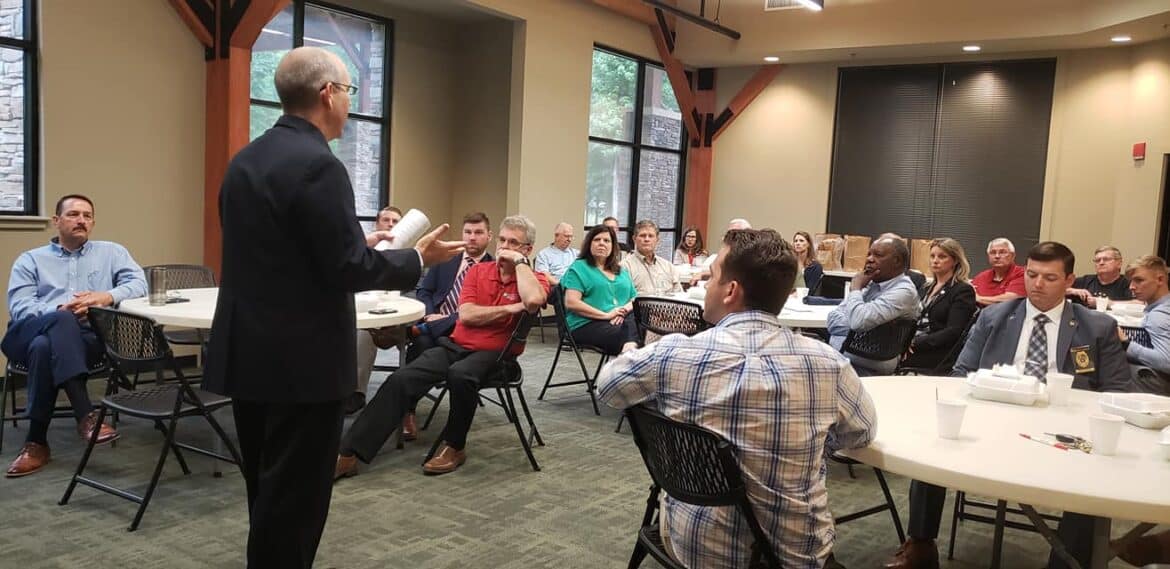
Senator Clyde Chambliss was the guest speaker for the Prattville Millbrook Sunrise Rotary Club this morning, as he gave an update on the recent Legislative session.
If you are a believer that the early bird gets the worm, and service before self is important, the Prattville Millbrook Sunrise Rotary Club may be the place for you.
To learn how to become a member, or for more information about the Prattville Millbrook Sunrise Rotary Club, visit https://www.facebook.com/PrattvilleMillbrookSuriseRotary
Settle in, get comfortable, because there is a great amount of information on a variety of topics in this article.
The club met bright and early at 7 a.m. in the NaturePlex at the Alabama Wildlife Federation.
Chambliss was introduced by Annette Funderburk.
“This session, we were going into a session with Covid…we did not know if we would meet a day, two days, two weeks or the entire session,” Chambliss said. “On the very first day we had a legislator and one staff member that were positive.”
With new protocols put into place for protection, there were new issues regularly.
Despite that, the session included 1,053 bills introduced, including about 600 in the House and 400 in the Senate.
Gambling: While the legislation on gambling in Alabama didn’t make it through the process this go around, it will most definitely come up again.
That legislation was composed of over 200 pages.
“I am not a proponent of gambling. It is a terrible way to fund government. However, if we are going to have it, and the votes looked like we would, I want it to be the best bill possible to ensure the longevity of financing our state.”
“Think about having been in the sun all day at the beach and how it just zaps your energy. You are tired. Gambling did that to our session. It just sucks the energy out of the room every time we deal with it and we deal with it almost every session. Again, it is a terrible way to fund government. If you enable it we know there will be people who get addicted to it and will lose everything and become basically a ward of the state. But I will say we already have gambling in this state and we really should deal with it. We have unregulated gambling in the state right now. I can tell you stories, second-hand, of trash bags full of money being wheeled across the parking lot…in this state…millions of dollars. The reason I know this story is because they hit a little bump or something and that trash can fell over and that money went everywhere. The authorities recovered it, and this was in northeast Alabama. We have it. It is here. And I wish we didn’t. But we do and we need to deal with it.”
Of the over 1,000 bills, 358 passed both houses.
“Roughly a third of the bills that are introduced are passed. That is about as much as we can get through. When times runs out, whatever is left has to start in the next session from ground zero.”
One of the primary objectives this session was to exclude the Federal stimulus from Alabama income tax. “To a lot of people, like restaurant owners, that is a big deal. We passed that.”
“We authorized the Jobs Act. That is a big deal in our state for economic development and recruitment. We used to borrow our incentive monies and that is a really dangerous type of thing. What we do now is more of a rebate program. If you come and you pay your taxes we will rebate those. That will help a lot with economic development.”
Other big issues were the Historic Tax Credit, Curbside voting ban, and the largest budgets in state history.
In the event of another issue like the Covid Pandemic, businesses and churches will now be allowed to stay open if they follow the proper guidelines, rather than being shut down as they were this past year.
Medical marijuana passed.
“Medical marijuana, that is talking about another two-edged sword. I know one little kid that lives down the street from me. They were having 30 seizures a day and now has about three a month. How do I deny that kid? Another is a young female that has had cancer and has been unable to work for about four years due to nausea and all the stuff that goes along with it. She got involved in one of the trials and if she walked into this room right now you wouldn’t know it. She is able to work and function. She is still having treatment and still has cancer. But all of the nausea went from 10 to zero.
“But then you have the slippery slope. We have (medical marijuana) now. We will see what we do. Hopefully we have enough controls with the Medical Marijuana Commission. We will see.”
Municipalities will now be able to utilize electronic signatures. Municipalities cannot do what they are not authorized by law to do. So we spent a lot of time authorizing things with changes over time.
Also, a Constitutional Amendment will be on the ballot next year for state parks. “We had a Constitutional Amendment a number of years ago, but that capital program has played out. We still have the revenue that was going to debt service, so we are asking the public do you want to use that same revenue we have already been using to do a new bond issue to do new capital improvements to state parks. I certainly support investment in our state parks.”
Left Lane Drivers – “Does anyone in here hate left lane drivers? A couple of years ago we passed a bill that made it clear you are supposed to drive in the right hand lane and the left lane is for passing. Well, the Department of Transportation would not put up signs. Well, they are going to put up signs now. We had to have a state law to do it, but they are going to do it.”
Utilities: “The City of Prattville started this initiative but municipalities everywhere will be able to take advantage of it. When you have sewer laterals going from your house to the street and they are in an older section of town….they start deteriorating and ground water goes into the sewer plant and overload the sewer. This starts going into the creek and overflowing. The cities cannot go on private property to correct that. However, it is a public health problem because sewer is going into yards, ditches, creeks, rivers. So now with the passage of this law, cities can enter into an agreement with the private homeowner, and the homeowner can repay the city over time. I am real hesitant about that type of legislation because, number one, public entities going on private property is a real issue. That is getting into the banking business and I don’t thing government should be in the banking business. However in this situation the banks really don’t care because these are not loans they are interested in making. So the way this was set up is that municipalities do not have the authority go to the property. They have the authority to go into an agreement with the homeowner. So there are some checks and balances.”
Incentives for prisoners to further their education: “For those incarcerated, about 94 percent will be let out at some point. Incentives would be for incentives to get an education, such as HVAC, Welding, etc. This way they could be considered for early parole. There was some opposition. But the whole point of the bill, he said, is if a prison can get out, have a job and provide for themselves and family there is a good chance they will not return to prison.”
Chambliss said that over the years DOC and Pardons and Parole have not done a good job in communicating with each other. This bill creates a committee of all of those parties, lets them communicate and designates a person on both DOC and Pardons and Parole.
“Their job is to get up every day and figure out what can we do working together to keep people from coming back to prison? And they really haven’t been doing that. So maybe this will work, maybe we will have to tweak it. But now they are talking.”
Chambliss was asked how the decision to add one year to terms for Municipal Mayors and Council members was made.
“There are nine classes of municipalities and they were divided up back years ago based on population. They do not change from that class as they grow and that complicates things. So municipalities have their elections at different times, depending on what class they are. There were some that had their elections during the Presidential election year. So what you have is county elections and municipal elections in the same year. It was creating a lot of confusion for people. I might vote at my house at location A in the county election, but location B on the city election and they are only a couple of months apart. This was an effort to correct that.
“In the future we will not have any municipal elections during a Presidential election year. So, how do you accomplish that? The easiest way was to make those terms for those councilors five years instead of four.”
The extension of one year is a one time thing, and will not be recurring.
Chambliss was asked about the Prison Bill, and where it stands.
“The prison issue…I have spent more time on the prison issue than all other issues put together since I have been in Montgomery. It has been that big of a deal, it is that important. It is that important for Elmore County but also surrounding counties.
“There are several reasons why I have spent so much time on it. One, I represent Elmore County. But the next biggest is that the corrections officers that are having to endure the situation that they are enduring is not right. It is not right to the inmates. But it is not right for our corrections officers. It is too dangerous. They don’t know if they are going to go home today or not. We as elected officials and the general public need to have an environment that is safe.”
Chambliss said because of the dangerous situation that corrections officers face daily, the quality of people applying for those jobs is going down. He addressed the issue of some corrections officers who have been caught bringing drugs and other illegal things into the prison setting.
“That kind of thing is going on. So if we have a safer working environment for our corrections officers we will start getting back the good guys who want to be corrections officers. We need that. It is so important.
“Obviously we have a Federal lawsuit and a DOJ investigation. I have been in the prisons. I have toured them. These people did do wrong, and they should be in there, no question. But when they are there, they are still people. They need to be in an environment that is safe and rehabilitative instead of hardening. Some of them are going to be harder and you cannot settle everyone’s problem. But if we have the programs…mental health is a big one.
“And this is very much related. When our law enforcement are arresting people and they know they have a mental health problem, where are they taking them? Hospital or jail. Most of the time jail because they are dangerous. They don’t need to be in either one. We have created three mental health crisis centers in the state and we are creating more. We have another one in this year’s budget so that law enforcement can take them to the mental health crisis center. They can stabilize them and then they say they, after stability, whether they go to hospital or the jail. It is a step to try get those with mental health problems from just going straight to our prison system where they get worse. They don’t get better. So it is a step.”
Autauga Probate Judge Kim Kervin spoke up on the issue, as she deals with mental health commitments in her line of work.
“It is bed space right now,” she said. “You can send them to the hospital if the hospital will accept them.”
But hospitals have limited space as well.
“So you have a hearing and you commit someone. You say that someone is a harm to themselves or others and then there is bed space. You spend four or five hours and you can’t find a bed and you are thinking, ‘I’m fixing to send someone back home that I’ve just said is a danger to themselves or others.”
Chambliss was asked about the lack of bed space, which was caused when larger mental health facilities were closed.
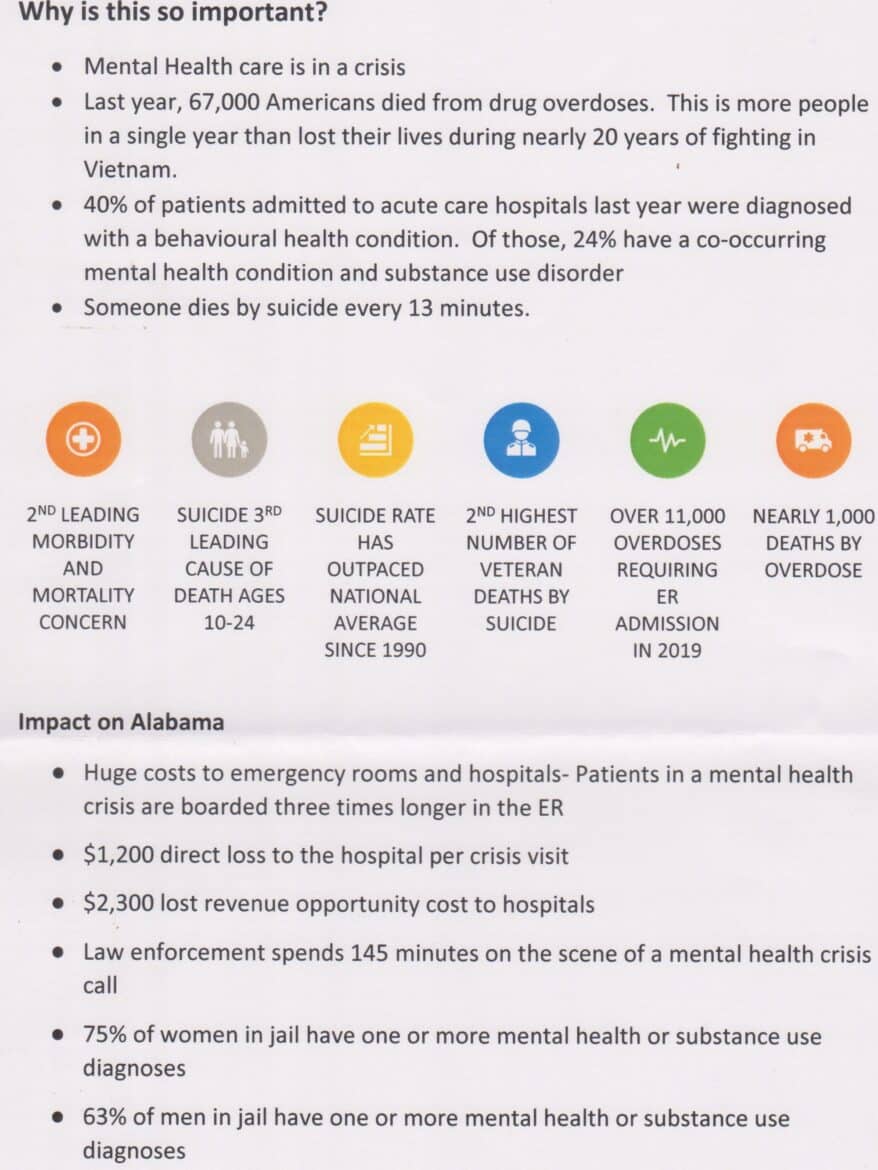
“Not giving proper care in congregated settings was part of it. But a more important part was the plan was to take those centers and put them in the communities all across the state. That was the plan. Then the Great Recession happened and they had shut them down because of budgeting and then they didn’t have the plan in place before they shut them down. That was the problem. You needed to have those community centers before you shut down the congregate centers. And we are still dealing with that. That was a bad decision and the wrong direction in my opinion. And we are still dealing with that and will be for a while. But these diversion centers are hopefully a step in the right direction.”
Chambliss was asked about Charter schools versus Public schools, and funding for both. This was particularly in relation to the Ivy Classical Academy Charter School which wanted to locate in the High Point Town Center which is in Elmore County and not Autauga Academy. Chambliss sponsored a bill that would allow a charter school to be called an Autauga County school, even if it is located in Elmore County. That bill did not get a House sponsor and did not make it to a vote.
“My first public vote in the Alabama Senate was dealing with Charter schools,” Chambliss said. “The Senate Pro Tem was the sponsor of the bill. I was brand new. Charter schools are public schools first of all. They basically become an autonomous school board so they have a board and an administration. The money that goes to public schools right now follows the child. So if they go to public school the money from the state goes to that school system. If they go to a Charter school then it goes to that school system.
“For me in Autauga and Elmore counties, the two lowest funded systems in the state that are achieving some of the best results…I voted no.” The bill eventually did pass, however, creating Charter schools.
Chambliss said that competition can be a good thing.
“Charter schools will be competing with public schools. Will that make them getter better? I don’t know. But I do say that Autauga and Elmore are two of the best in the state. But you have to realize we are the worst in the nation. So that is not really a lot to brag about.”
In speaking of Ivy Classical Academy, Chambliss said, “The Charter school was a set of private individuals who know the law and looked at the law and then applied for a charter school. They met all of the criteria and were granted their charter by the State Charter commission.”
However, the exact location of where the school could locate is still up in the air. Chambliss said he would not be opposed to it locating at Highpoint, as it would bring more activity to the center that has thousands of square feet of unused space.
“I see no downside to that. Elmore County is not too happy about that. Because it is coming into their territory. However, for the long term good of everybody I think that was a good move. Obviously it didn’t get through the legislature so that is a moot point. They will, I assume, have a facility in Autauga County and move forward. If they don’t the legislation may come back. I don’t know.”
Chambliss was asked who has the authority to reject or accept a Charter school in Elmore County?
“Nobody in Elmore County has that authority and here is why. When the legislation was first passed there were what was called Charter school enablers. And each county’s board of education had that opportunity to say ‘We will be the Charter School enabler’ meaning they could vote yes or no. Autauga County and Elmore County…neither one became Charter School enablers. So that authority resides at the State Charter School Commission. Now I think Elmore County will possibly become a Charter School enabler but I don’t know the status of that. So right now the only one who has any say on that is the State Charter School Commission.”